The Rescue Mission to Save Aouda from Suttee
Around the World in Eighty DaysThe Rescue Mission to Save Aouda from Suttee is a major turning point in Phileas Fogg’s journey: faced with a stranger’s imminent death, he sets aside the schedule and personal risk that have governed his expedition. The rescue exposes Aouda’s supposed consent as a false account, tests Fogg’s resolve, and gives Passepartout a decisive role in saving her.
The procession and the truth about Aouda
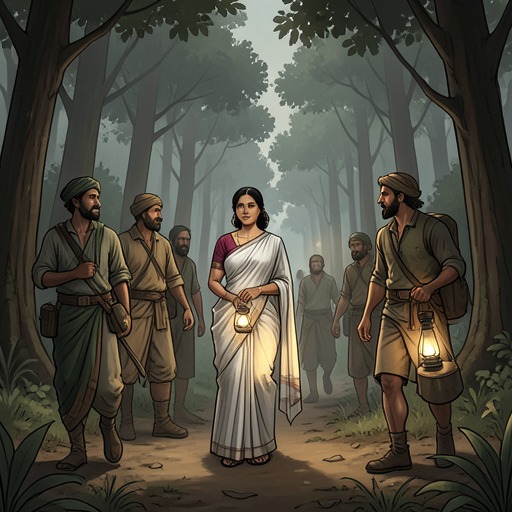
The party first encounters the crisis as a procession moving through the forest. It includes religious attendants, armed guards, musicians, and a young woman whose elaborate clothing and jewelry distinguish her from the men surrounding her. A dead rajah is carried on a palanquin, and the procession is taking the woman toward a ceremony in which she is expected to die alongside her husband. Sir Francis Cromarty recognizes the event as suttee. When Fogg asks what the term means, Sir Francis explains that the woman is due to be burned at dawn and describes the act as voluntary. Passepartout reacts with indignation, but that initial explanation does not settle the question of whether the woman has chosen her fate.
The guide directly challenges the claim of consent. He says that the planned sacrifice is not voluntary and that the affair is widely known in Bundelcund. He identifies the woman as Aouda, a celebrated beauty of the Parsee community and the daughter of a wealthy merchant in Bombay. She was orphaned, educated in English, and married against her will to the old rajah of Bundelcund. After escaping the fate imposed on her, she was recaptured; the rajah’s relatives, who had an interest in her death, then committed her to the ceremony. This account changes the stakes of the scene: the rescue is not an intrusion into a freely chosen rite, but an attempt to save a woman being held against her will.
Fogg chooses to intervene
Once the guide confirms that the ceremony will take place at dawn, Fogg asks whether the party can save Aouda. He has twelve hours available, he says, and can devote them to the attempt. The decision puts the expedition itself at risk. The narrator makes clear that the plan could cost the travelers their lives or their liberty and could jeopardize the success of Fogg’s tour. Yet Fogg does not hesitate, and Sir Francis becomes an enthusiastic ally. Passepartout is ready to follow the plan; watching his master commit to Aouda’s rescue, he sees compassion beneath Fogg’s famously controlled manner and begins to love and admire him.
The guide’s knowledge of the area makes him essential to the undertaking. He leads the party toward the Pagoda of Pillaji, where Aouda is being held. They conceal themselves in nearby woodland, close enough to hear activity around the temple, and consider how to reach her. The possible approaches are uncertain: they might try a door while the assembled party slept, or make an opening through the wall. The guide knows the temple, but the travelers cannot determine in advance which route will be practicable. One point is not in doubt: they must act that night. By daybreak, Aouda would be beyond their reach.
A blocked entry and a last chance
After nightfall, the party makes a reconnaissance of the temple. The attendants are settling into a stupor caused by a mixture of opium and hemp, giving the rescuers a possible opportunity to approach. From the stream nearby, they can see the pyre and the temple beyond it. The arrangement of the scene makes the deadline tangible: the ceremony is prepared, and the rescuers have only the remaining hours of darkness in which to act.
The party chooses to try the temple wall. In the darkness, the Parsee guide and Passepartout use pocket knives to loosen bricks and make a narrow opening. Their work is interrupted by cries from within and outside the building. Unsure whether they have been discovered, they withdraw to the woods and wait. The interruption proves costly: guards take up positions behind the temple, closing off the approach. Sir Francis sees no remaining option but to leave; Passepartout is overcome with frustration, the guide is furious, and Fogg remains outwardly calm. The carefully planned entry has failed, and the dawn ceremony is beginning.
As the crowd gathers, Fogg and Sir Francis see Aouda brought out in a state of stupor. They follow with the procession toward the pyre. When the ceremony starts, Fogg is about to rush forward, but Sir Francis and the guide restrain him. The attempt now appears to leave no opening for a direct rescue. At that point, the scene abruptly changes: the figure of the dead rajah rises, takes Aouda in his arms, and leaves the pyre. The assembled attendants and guards are thrown into confusion, creating the brief interval the rescuers need.
Passepartout’s disguise and the escape
The apparent return of the rajah is Passepartout’s audacious deception. He had climbed into position earlier and, concealed by the darkness and smoke, taken Aouda from the pyre while impersonating the dead man. His action succeeds where the attempted entry through the temple wall did not: rather than reach Aouda inside the guarded building, he uses the ceremony’s own spectacle to carry her out before those present understand what has happened. The rescue depends not only on Fogg’s decision to intervene but on Passepartout’s ability to improvise at the moment when the original plan has failed.
Passepartout joins the others, and the party disappears into the woods with Aouda. Their elephant carries them away at speed. The escape does not go unnoticed for long: a shot passes through Fogg’s hat, and the guards and attendants pursue the fugitives after recognizing that an abduction has taken place. The party nevertheless gains distance and gets beyond the reach of the shots and arrows. Aouda has been removed from immediate danger, though the rescue begins a new stage of responsibility for Fogg and his companions: she is now traveling with them rather than returning to her former life.
The episode changes the relationships within the party as well as Aouda’s immediate circumstances. Fogg’s willingness to sacrifice time, liberty, and the prospects of his wager reveals a moral commitment that his earlier reserve had concealed. Passepartout’s daring action makes him the practical agent of the rescue and confirms the loyalty that accompanies his admiration for Fogg. Structurally, the failed wall entry and the unexpected disguise transform the scene from a planned intervention into a narrow escape. Aouda’s survival rests on the companions’ shared purpose, but the decisive opening comes from a performance that turns the ceremony’s expectation of death into a means of flight.